Transiting the Northwest Passage and
the Race for the North Pole
PART I
Origins of the Saga: “Shadows of the Past” – The Search for the Northwest Passage
The search for the Northwest Passage has a long and storied history. Even casual students of Canadian history will recognize some of the names of early explorers in their search for a northern route and shortcut to the riches of the Orient. Out of the mists of time emerges the historical record revealing that the first person ever to attempt to reach the North Pole was a Greek geographer and explorer by the name of Pytheas of Massalia* (*a Greek colony located at today’s Marseille, France) who reached the 70th parallel somewhere between Iceland and Norway in 325 B.C., and thus the first to penetrate the Arctic Circle to describe the Arctic (the “Thule”), the midnight sun and polar drift ice. He scientifically linked the Arctic tides to the phases of the moon, and correctly identified that the ‘pole star’ was not truly at the North Pole. Using a ‘gnomon’ connected to observations of the sun, he calculate remarkably accurate latitudes for Northern Europe.
Legend has it that the next to venture north were some Irish Monks (Papar) who reached 61° north in 825 A.D. to settle in “Iceland”. They were followed by a Norwegian named Othere who reached 67° north in 870, which led to the expansion of Viking settlements in Iceland, and the evacuation of the Irish Monks in the face of the advancing “pagan hoards”. Then we fall into more familiar territory for most Canadians who remember some of their history from early school days: explorers such as Eric the Red of Norway, who was banished from ‘Iceland’ for murder, who sailed west in 983 to reach 73° north, and discovered and settled ‘Greenland’. From there, his son, Leif Erikson (‘Leif the Lucky’), sailed west from Greenland on explorations of his own; and his voyage, as documented in the Icelandic Vinland Sagas, describes the lands west of Greenland which Leif called ‘Helluland’, ‘Markland’ and ‘Vinland’. According to these records, Leif reached North America around 1000 AD, roughly 500 years – or half a millennium – before Christopher Columbus’s voyage of 1492. Leif established a temporary settlement at “L’Anse aux Meadows” in modern-day Newfoundland; and legend has it that he may have travelled a short way up the St. Lawrence, or even along the coast of Gaspe.
The circumnavigation of the globe by Portuguese explorer Fernando Magellan’s expedition, 1519-1522, revealed a new southwester route to China, but more importantly, it caused a reconstruction of world maps to conform to this newly acquired knowledge of a ‘spherical’ earth. Magellan’s discoveries initiated intense competition and a series of adventurous voyages to find a corresponding northern “arctic route” to the Orient known as the Northeast and Northwest passages, contested most especially between England and Spain.
As is well known by most elementary schoolchildren, “Columbus sailed the ocean blue, in 1400 and 92”; and although he is credited with the discovery of North America, he actually landed in the West Indies. As far as our story and Canada is concerned, the English Cabot brothers, John and Sebastian, reached 62°30’ north, and discovered the fabulous fishing grounds off the Grand Banks of Newfoundland in 1497-98. They were followed in quick succession by Fernandez of Portugal (61°north) in 1500; the Willoughby-Chancellor expedition of England (72° north) in 1553; and then by another Englishman, Stephen Burrough, (71° north) in 1556. Now we are getting into the more familiar names of explorers after whom land marks are named; names such as Sir Martin Frobisher of England who discovered ‘Frobisher Bay’ (63° north) in 1576-78. He was followed by the Pet-Jackman expedition of 1580 (72° north), then by Brunel of Holland (71°40’ north) in 1584, and then again by Englishman John Davis, 1585-87 (73° north), after whom the ‘Davis Straits’ are named. We could continue like this, year-after-year, decade-after-decade, but now we are going to concentrate on those explorers of some renown that we know best.
Therefore, we skip forward to Englishmen Henry Hudson and his son who discovered “Hudson’s Bay” in 1607 (81°30’ north), both of whom were set adrift in a lifeboat by mutinous shipmates who were disillusioned by their quest. This ill-fated venture was followed by a series of explorers from England, Denmark, Russia, Holland, and Germany, when the Bylot-Baffin expedition from England reached ‘Baffin Island’ (78° north) in 1616. Danish-born Vitus Bering began his explorations in 1728 (“The First Kamchatka Expedition”) for Peter the Great of Russia “to determine where Asia ends and America begins” (60° north); and in 1741, he discovered the ‘Bering Strait’ between Asia and North America, and then went on to discover what came to be known as ‘Alaska’. Capt. (N) James Cook also explored the Pacific coast of our continent (70°41’ north) in 1778; and later, Capt. (N) George Vancouver picked up where his mentor left off, travelling in tandem up the west coast with the Spanish explorer Galiano in 1792, only to discover that “Vancouver Island” was indeed an island as Cook had predicted but had never proven.
Looking eastward for a moment, the first English attempt to find the Northeast Passage had been made in 1553 by three ships under the command of Sir Hugh Willoughby, but the commander and crews of two vessels were lost. The third vessel, under Richard Chancelor, entered the White Sea, and wintered near the site of Archangel, thus opening communication between Russia and the rest of the world, and initiating the famous Muscovy Company in 1555.
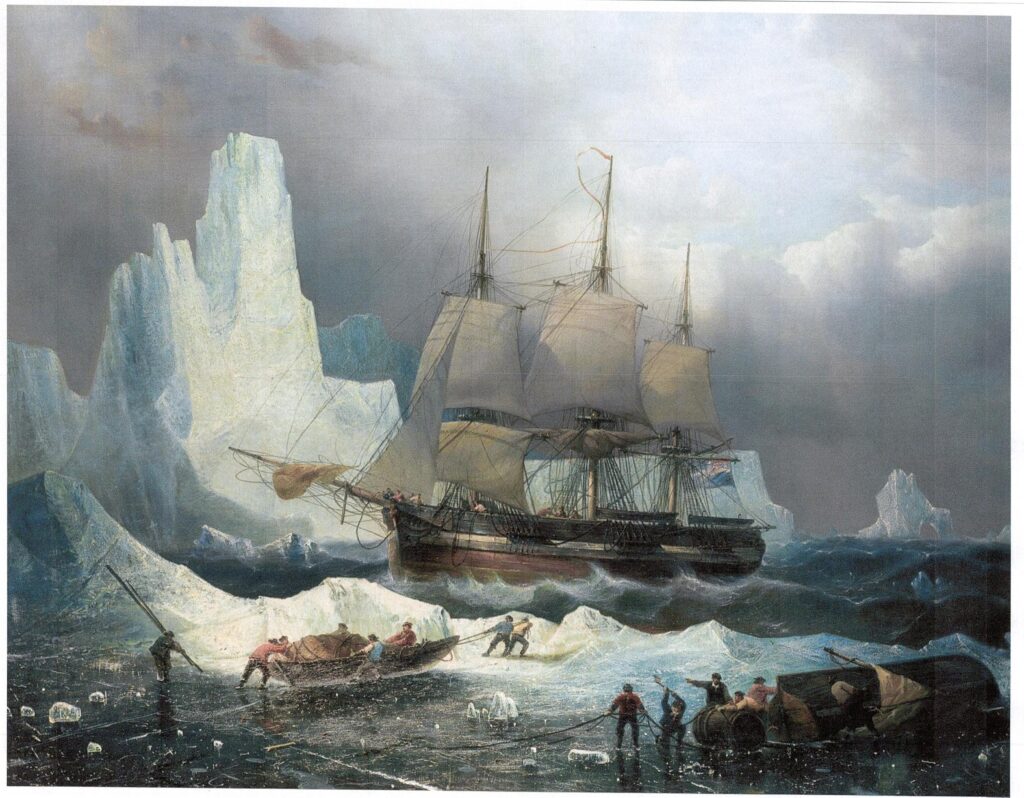
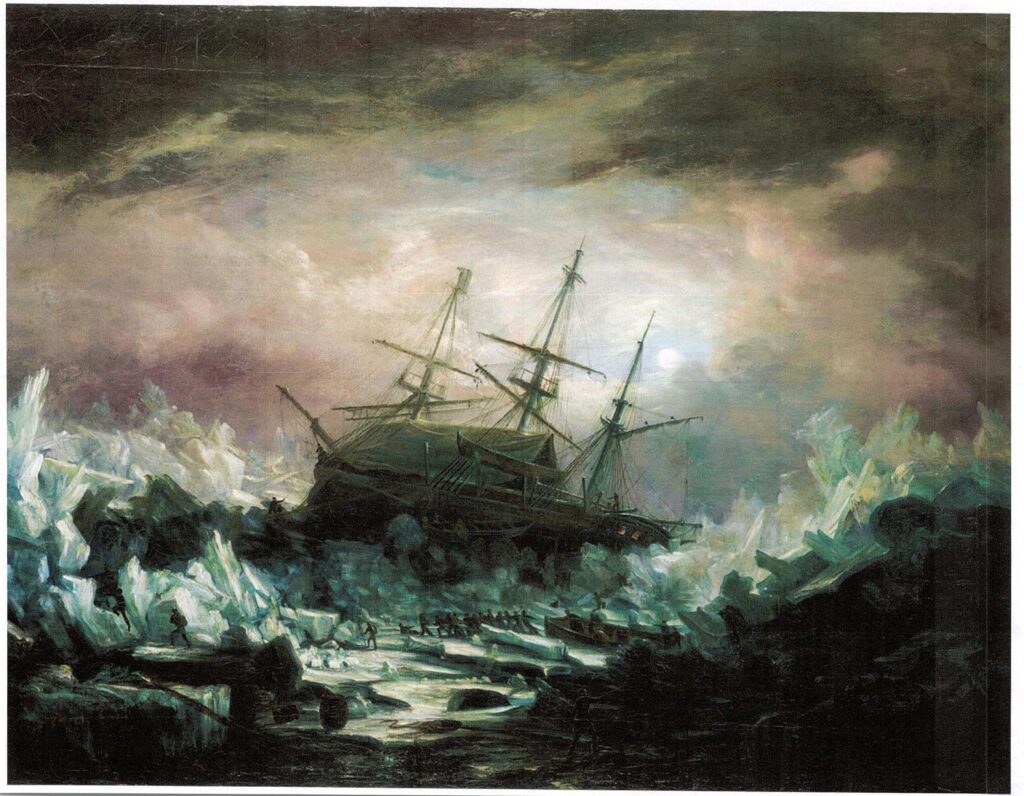
Skipping forward some years, and looking again westward, the dawn of the nineteenth century saw the spirit of exploration seize the imagination of English mariners, especially for the arctic regions. Following notable discoveries by Sir John Franklin by land (1818 and 1819-21) and W.E. Parry by sea (1819-20, 1824-25, and 1827), there occurred the last tragic expedition of Sir John Franklin by sea. He sailed for Lancaster Sound in 1845 with the “Erebus” and ”Terror”; but the ships became locked in pack ice, and the whole expedition perished to a man. The search to determine the fate of Franklin was conducted on an unequalled scale from 1846 to 1853, without success. Thirty ships and land parties were engaged in thoroughly searching the archipelago of North America; sledge journeys of more than ten thousand miles were made, and two ships had to be abandoned, ice-beset. The ‘Franklin Mystery’ was only solved by Leopold McClintock who discovered the frozen bodies of expedition crew members in 1859-1860, but Franklin’s body has never been found. Following this disaster, a new route was opened toward the pole via Smith Sound. Exploration by Kane, then ventures I.I.Hayes (1860) and Charles F. Hall (1864-69 and 1871-73) reached the Arctic Ocean; and later, advancement toward the North Pole was made by Greely (1881-84) and the indefatigable Robert E.Peary (1893-95).
Editor’s Note: The information contained in this article has been collected and condensed from sources which are considered to be in the “public domain”, and therefore no particular author or source has been cited.
PART II
The Saga Unfolds: “A Spotlight on the Role of the RCMP, the RCN and the Northwest Passage”
The first person to “officially” transverse the Northwest Passage (NWP) was neither an Englishman (RN) nor a Canadian (RCN), but a Norwegian explorer by the name of Roald Amundsen who led the first successful expedition to transverse the Northwest Passage by sea. Sailing from east to west with a crew of six in a small 40-ton, shallow-draft sloop named “Gjoa”, chosen for its ability to navigate shallow Arctic straits, Amundsen completed the long-sought Arctic route, linking the Atlantic and Pacific oceans.
Amundsen and his crew spent nearly two years (1903-1905) in a natural harbour on the south coast of King William Island, which he named “Gjoa Haven”. While traversing the NWP, the crew conducted magnetic and meteorological observations, confirming the movement of the North Magnetic Pole. Just as importantly, Amundsen learned crucial Arctic survival skills from the local Netsilik Inuit, including the importance of wearing reindeer skins and using dog sleds, which were critical to his survival and future successes. On August 13, 1905, the Gjoa passed through the Simpson Strait, reaching Cambridge Bay and completing the connection to the Pacific. The expedition arrived in Nome, Alaska, in 1906. As we have seen, while many explorers such as Henry Hudson and Sir John Franklin failed or died attempting to find or traverse the passage, Amundsen’s smaller ship and the use of methods of survival learned from indigenous people, led to his victory; and he accomplished this goal shortly before winning the race to the South Pole just days ahead of R.F. Scott in 1911.
As a footnote to this saga, Robert Peary, along with Matthew Henson and four Inuit men, claimed to be the first to reach the North Pole in April of 1909. However, this claim has been disputed in terms of the accuracy of their navigating records; and many historians consider the May 1926 aerial expedition led by Roald Amundsen to be the first “undisputed”, verified arrival, when he crossed over the North Pole in the airship “Norge”. This makes Amundsen’s heroic story even more impressive because he would become the person to have reached both the South and North Poles first!
Unfortunately, in June 1928, Amundsen led a search party of five others in the “Norge” to find fellow explorers who had crashed the airship “Italia” while returning from the North Pole. Tragically, the “Norge” also crashed in the rescue attempt; and although the wing-float and the gas tank of the “Norge” were recovered, the wreckage and the bodies of Amundsen and his crew were never found. Regardless, the “Amundsen Saga” lives on in the myth-like annuls of heroic polar deeds.
But what about the Canadian part of this story? Where do we fit in?
The RCMPV St. Roch was built in 1928 at the Burrard Dry Dock Shipyards in North Vancouver as an Arctic supply and patrol vessel for the RCMP. She was a wooden schooner powered by sails and an auxiliary engine, with an overall design based on Roald Amundsen’s ship “Maud”. She was made primarily of thick Douglas fir, and very hard Australian “ironbark” eucalyptus on the outside, and an interior hull reinforced with heavy beams to withstand ice pressure during her Arctic duties.
Under the command of Sargent Henry A. Larsen, she was the second vessel (after the Gjoa) to transit the Northwest Passage, but the first to complete the Passage in the west to east direction (Pacific to Atlantic Ocean, 1940 -1942), using the same route that Amundsen on the Gjoa had traversed east to west, 38 years earlier. Taking the treacherous southerly route through the arctic islands, she became trapped in the ice for two winters, and did not reach Halifax until 11 October, 1942. However, in 1944, she became the first vessel to make a return trip through the Passage, traversing the more northerly route considered to be the “true Northwest Passage”, through Lancaster Sound and Barrow Strait. Moreover, she was also the first vessel to navigate the passage in a single season, and in a record 86 days, and the first vessel to traverse the passage in both directions – “a wooden ship doing what steel titans couldn’t.”
In May 1950, the St. Roch made a southern voyage from Halifax, through the Panama Canal to Vancouver, thus becoming the first ship to circumnavigate North America. In all, the St. Roch made three arctic voyages, thus strengthening and ensuring Canadian Arctic Sovereignty.
HMCS Labrador (AW 50) was a pioneering Royal Canadian Icebreaker that became a famous ‘landmark vessel’ as the first deep-draft warship to navigate the Northwest Passage in a single season, proving that heavy, deep-draft ships could navigate the route. She commenced the voyage from Halifax in July 1954, navigated the icy Passage route to the Pacific in 66 days, and effectively became the first ‘deep-draft’ ship to circumnavigate North America via the Northwest Passage and the Panama Canal. Her deployment and mission were essential to “showing the flag” in northern waters during the emerging Cold War, thus securing Arctic sovereignty against all foreign competing claims.
Laid down in the Marine Industries shipyard in Sorrel, Quebec in January of 1949, and launched in in December of 1951, her construction was based on the design of existing U.S. icebreakers. At 82 meters (369 feet) in length, and with a displacement of 6,490 tons, she was Canadian–modified to adopt a 41 mm-thick, rounded steel hull so the bow could rise up on ice flows, and with her sheer weight smash a path forward through the ice. Powered by six 2,000 horsepower diesel engines, she was capable of reaching a speed of 16 knots. She had big screws tucked away well below the plimsoll line, well out of reach of tumbling surface ice. She was also fitted with retractable stabilizing fins and heeling tanks on the port and starboard sides capable of pumping water from side to side at the remarkable rate of 40,000 gallons per minute, thus allowing her to roll in pack ice.
With a crew of 225 officers and men, and “sporting” three Piasecki HUP-3 helicopters for ice reconnaissance which could all be stored in her hanger during rough weather, the Labrador was not simply an ice-breaker. Equipped as she was, she was able to provide the necessary assistance in the construction and supply of Distant Early Warning (DEW) Line sites, transporting equipment and personnel to remote Arctic locations. She also conducted crucial and extensive hydrographic surveys in the eastern Arctic and mapped the ocean floor, which was critical for later military and commercial navigation. In this manner, she facilitated critically important scientific research, and provided rescue and salvage services, marking a key milestone in Canadian Arctic maritime history before being transferred to the Department of Transport (later, the Canadian Coast Guard) in 1958, where she served as CCGS Labrador. In her new role, she still served as an icebreaker in the St. Lawrence and the Arctic until her retirement in 1987.
As a footnote, by 1955, once Canada and the USA had begun construction on the DEW line, the Labrador was tasked to chart and clear the passage in the Foxe Basin area so that equipment and supplies could be taken ashore by landing craft. After returning to the Arctic in 1956, the Labrador aided the American icebreaker Edisto in getting a supply convoy from the Foxe Basin to the Bellot Strait. During the transit, the Edisto – which had become icebound and had broken a screw – was rescued by the Labrador. Then, in the fall of 1957, three US Coast Guard Cutters – the Storis, the Bramble, and the Spar – were transiting the Northwest Passage. Due to the uncertainty of having a clear passage through the Bellot Strait, the Labrador rendezvoused with the US squadron on the western end of the Ballot Strait, which turned out to be ice free, and then escorted them through. Notably on another occasion, the Labrador also rescued the American scientific vessel Monte Carlo which had become trapped in ice.
In reaching the final analysis for PART II, “The Saga Unfolds”, it can be clearly seen that the Labrador laid the essential groundwork for modern Canadian Arctic patrol vessels, such as the HMCS Harry DeWolf, which now conduct similar Arctic sovereignty missions, and to which class of vessels we now draw your attention in PART III, “The Saga’s Latest Chapter”.
PART III
The Saga’s Latest Chapter: “An Arctic Offshore Patrol Vessel under the Light of the Aurora Borealis”
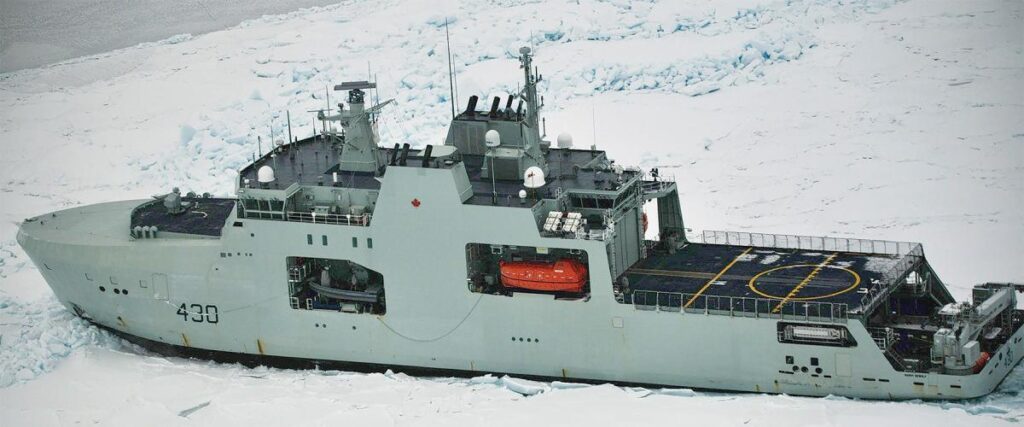
HMCS Harry DeWolf (AOPV 430) is the lead ship of her class of offshore patrol vessels for the Royal Canadian Navy (RCN). The class was derived from the Arctic Offshore Patrol Ship project as part of the National Shipbuilding Procurement Strategy, and is primarily designed for the patrol and support of Canada’s Arctic regions. Named after Vice Admiral Harry DeWolf, a decorated naval officer who served during World War II in European waters, then as the RCN’s Chief of the Naval Staff (former head of the RCN) during the early Cold War, the vessel was ordered in 2011, the keel officially laid down in 2016 – the first naval construction in Canada since 1998 – and launched ion 15 September 2018. The vessel completed sea trials in July 2020, was delivered to the RCN on 31 July 2020, and then began her post-acceptance sea trials. Harry DeWolf was commissioned on 26 June 2021.
The Harry DeWolf-class offshore patrol vessels are designed for use in the Arctic regions of Canada for patrol and support within Canada’s exclusive economic zone. The vessel is 103.6 m (339 ft 11 in) in length overall, with a beam of 19.0 m (62 ft 4 in). The ship has a displacement of 6,615 metric tons (6,511 long tons), and has an enclosed foredeck that protects machinery and work spaces from Arctic climates. The vessel is powered by a diesel-electric system composed of four 3.6-megawatt (4,800 hp) MAN 6L32/44CR four-stroke medium-speed diesel generators and two electric propulsion motors rated at 4.5 megawatts (6,000 hp) driving two shafts. Harry DeWolf is capable of 17 knots (31 km/h; 20 mph) in open water, and 3 knots (5.6 km/h; 3.5 mph) in 1-meter (3 ft 3 in) first year ice. The ship is also equipped with bow thrusters to aid during manoeuvres and docking procedures without requiring tugboat assistance. The ship has an operational range of at least 6,800 nautical miles (12,600 km; 7,600 mi) at 14 knots (26 km/h; 16 mph) in open water, and an endurance of 120 days. The vessel is equipped with fin stabilizers to decrease roll in open water, which can then be retracted during ice-breaking.
Harry DeWolf is able to deploy with multiple payloads, including shipping containers, underwater survey equipment or landing craft. Payload operations are aided by a 20-metric-ton (20-long-ton; 22-short-ton) crane for loading and unloading. The ship is also equipped with a vehicle bay which can hold pickup trucks, all-terrain vehicles and snowmobiles. She also has two 8.5 meter (27 ft 11 in) multi-role rescue boats capable of over 35 knots (65 km/h; 40 mph). The ship is armed with one BAE Mk 38 25 mm (0.98 in) gun, and two M2 Browning machine guns. The patrol ship has an onboard hanger and flight deck for helicopters up to the size of a Sikorsky CH-148 Cyclone. She has a compliment of 65, and accommodation for a possible 85-87 personnel.
Harry DeWolf embarked on her inaugural deployment 3 August 2021 and participated in Operation Nanook, Canada’s annual sovereignty operation and manoeuvre warfare exercise conducted in the Arctic, alongside Maritime Coastal Defence Vessel (MCDV) HMCS Goose Bay and elements of the Canadian and United States Coast Guards. During this exercise, a new underwater listening device called the Towed Reelable Active-Passive Sonar (TRAPS) was trailed, testing advanced acoustic sensing capabilities for anti-submarine warfare operations. The ship then proceeded through the Northwest Passage, and docked at CFB Esquimalt on 4 October 2021. Harry DeWolf left CFB Esquimalt on 22 October 2021, and sailed to the Caribbean Sea and Atlantic Ocean via the Panama Canal. During the second leg of her journey, she took part in Operation Caribbe – Canada’s contribution to the US-led anti-drug smuggling effort Operation Martillo – and seized almost 3,000 kilograms (6,600 lbs) of cocaine. She returned to CFB Halifax on 16 December 2021, becoming the first Canadian naval vessel to circumnavigate North America since HMCS Labrador made her similar historic voyage in 1954.
In August 2022, Harry DeWolf was among the Canadian warships that were to be deployed to the Arctic as part of the multinational military exercise Operation Nanook. However, after two of four generators on the ship ceased functioning, the ship’s participation in the exercise was cancelled due a need to return to Halifax for repairs. In August 2023, after an operational hiatus for the necessary repairs and extensive sailor training, Harry DeWolf departed from her home port of Halifax to once again join the 2023 iteration of the annual sovereignty Arctic deployment, Operation Nanook.
Since Harry DeWolf’s completing Operation Nanook in 2023, she has remained highly active. As of 2026, she has completed a further two significant operational deployments, and one major regional outreach tour. The first major deployment entailed the 2024 version of Operation Nanook, but this time she was also engaged with HMCS Margaret Brooke in multinational exercises focusing on maritime interdiction gunnery exercises while partnered with, among others, the US and Royal Danish Navies. During this deployment, the ship played a vital role in notably assisting in a search and rescue (SARS) mission, saving a crew of four in distress who had been stranded for three days without food or water near Arctic Bay after their engine failed. Following this 2024 Arctic mission, the ship conducted a public outreach and recruitment tour through the Great Lakes (October-November 2024), stopping at various ports, including Kingston and Windsor, where she docked at Dieppe Gardens.
The second operational deployment was a high-impact, counter-narcotics mission to disrupt trafficking – another Operation Caribbe (January- March 2025) – which took place in the Caribbean Sea and Eastern Pacific Ocean with a US Coast Guard Law Enforcement Detachment; and on 1 March, the operation netted the seizure of 750 kilos of cocaine, with an estimated street value of $29.9 million CAD. The ship returned to Halifax on 22 March 2025, after approximately eight weeks at sea.
Specifically commenting on the first deployment of the TRAPS, on 1 October 2021, Timothy Choi reported the following:
On 1 October, 2021, HMCS Harry DeWolf, first-of-class of the Arctic & Offshore Patrol Vessels, arrived in Vancouver following its 10,000 km long journey from Halifax via the Northwest Passage – the first RCN vessel to do so since HMCS Labrador accomplished this feat in 1954. Along the way, the Harry DeWolf (HDW) visited villages and hamlets, including Pond Inlet, Grise Fjord, Arctic Bay, Cambridge Bay, and Kugluktuk. It also visited Nuuk and Unalaska, its first foreign ports. It conducted exercises with the Rangers, employed its new landing craft and multi-role boats to land sailors and pick up visitors along various Arctic beaches, and conducted the usual sovereignty and constabulary duties expected of a patrol vessel.
But very quietly, via a simple Flickr image upload, the RCN revealed that Harry DeWolf was also trailing a new military function: an Arctic ‘Anti-Submarine Warfare (ASW) capability. On the same day the ship arrived in Vancouver, the ship’s image techs were finally able to upload their high-rez photos from the trip. One of those was a visually unremarkable image. Usually, sailors pulling on a cable isn’t of much interest, but in this case, the caption revealed much more:
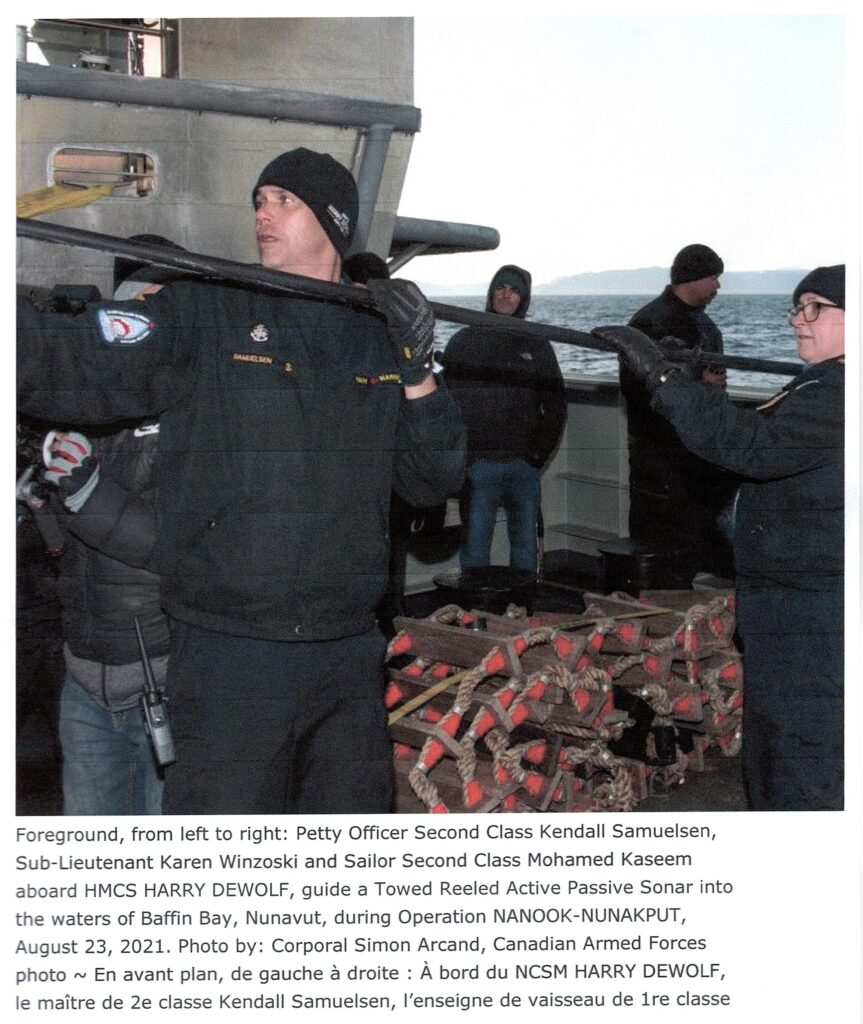
“Harry DeWolf was carrying a ‘Towed Reelable Active Passive Sonar’, or TRAPS. Self-contained in a twenty-foot shopping container, this towed sonar with both active and passive components was announced by GeoSpectrum Technologies at CANSEC 2018 as a cheap modular ASW solution for offshore patrol vessels, citing specifically its anticipated use on both the Kingston and DeWolf classes. In the years since, it has been trialled on board the Kingston class MCDVs, but this was the first time that the RCN had admitted to its use on board the new Harry DeWolf. It is suspected that the testing location was the part of Baffin Bay close to Devon Island, as Harry DeWolf had visited Grise Fjord on October 23rd, and had arrived in Admiralty Inlet (outside Artic Bay) on the 24th.
“Of course, none of this was surprising to those who had been following AOPs development closely; the ship’s requirements included the ability to operate towed bodies from its stern deck, and what else would that be if not a sonar? Although some are still somewhat skeptical of its utility in icy waters due to its vulnerability to ice, it’s clear that there are areas of the Canadian Arctic where waters are open enough for towed sonar.
“Interestingly, this ability makes Canada the only country with an Arctic patrol vessel equipped with a modern ASW sensor. The Danish Thetis class have been the only other ice-capable patrol ships built to date with towed sonars, but those were removed in the first decade of the new millennium due to their age and limited utility in ice-covered waters. With the TRAPS’ arrangement being significantly more modular than the integrated below-decks system of the Thetis class, this arrangement should offer the Harry DeWolf class much more flexibility in terms of ‘when’ and ‘when not’ to be equipped with them.”
On October 16 2021, one insightful reader of Choi’s report replied with the following observation and anecdote:
“This use of towed sonar in the Arctic, for Canada, is indeed a major effort to close the gap heretofore in our offshore surveillance. With our huge Arctic expanse, with fortunately several choke points, now opening for more passages from both friends and other potentially less friendly, an ability to ‘see’ what’s going on is vital to OUR interests. In reply to a Canadian officer’s query, “When are you guys going to tell us when you pass one of your boomers (SSBNs) through our Arctic?”, a U.S.N. Admiral smiled: “When you can tell us it’s there.” So, now we can.”
On 25 October 2021, another astute observer commented: “Being able to ‘see’ denotes surveillance. But what about ‘control’, which is the other side of the coin? What active/passive measures to coerce an intruder are available to us, if only in extremes? Is it even possible given the vast expanses between those ‘choke points’? Such measures would make northern deterrence more credible. It would add heft to whatever aerospace surveillance/control measures Canada will be implementing as part of NORAD renewal.”
Editor’s Note: The RCN has produced a mini-documentary on HMCS Harry DeWolf’s circumnavigation of North America, The 11-minute video is accessible at the following link:
Acknowledgements: The Naval Museum of Manitoba gratefully acknowledges the contributions from several sources, many of which are in the ‘public domain; but particularly acknowledged are:
1. Choi, Timothy. “HMCS Harry DeWolf transits Northwest Passage, tests ASW towed sonar.” Canadian Naval Review. 1 Oct. 2021.
2. Weir, Garry. Editor of For Posterity’s Sake, and Member of the Naval Museum of Manitoba’s Board of Directors.
This presentation was created by J.O. Dawson, Managing Editor and Director of Education and Public Affairs of the Naval Museum of Manitoba.